
Why Is Red So Important in Chinese Culture?
Red in Chinese culture most often conveys happiness, good fortune, vitality, and public celebration. That is why it appears so prominently at Lunar New Year, weddings, shop openings, and other joyful occasions. Yet red does not carry one fixed meaning in every century or setting. Its significance comes from a layered history of pigments and lacquer, ritual associations, clothing, gifts, visual contrast, and modern political and commercial design.
Red in Chinese Culture at a Glance
- Most familiar meanings: joy, auspiciousness, prosperity, vitality, and celebration.
- Festival uses: red couplets, paper cuttings, lanterns, clothing, and envelopes.
- Material history: mineral pigments such as cinnabar, red glazes, textiles, seal paste, and carved lacquer.
- Important caution: color symbolism changes with the object, occasion, region, and historical period.
What Does Red Mean in Chinese Culture?
The simplest answer is that red is an auspicious color associated with life, happiness, prosperity, and occasions worth celebrating. The Smithsonian’s National Museum of Asian Art connects these positive meanings with red’s visual and physical associations with the sun, blood, and fire. Because red draws the eye so strongly, it also works as a social signal: a red door decoration, garment, package, or lantern can immediately mark an event as special.
This symbolism is relational rather than automatic. Red does not make every object “lucky,” and the same shade can communicate celebration, official authority, artistic emphasis, or modern political identity. A red wedding garment and a red collector’s seal belong to different systems of meaning even though they share a color.
Chinese also has a historically rich vocabulary for reddish colors. Modern hong (红/紅) is the everyday word for red, while terms such as chi (赤), zhu (朱), and dan (丹) can evoke particular hues, substances, or literary associations. Scholars of oracle-bone inscriptions caution that early color words did not always divide the visible spectrum in the same way as modern color categories. It is therefore safer to trace particular uses than to claim that one unchanging “Chinese meaning of red” has existed from the beginning of history.
Historical Roots: Pigment, Lacquer, Ritual, and Status
Red first has a material history. Iron-rich earths could produce red pigments, while the mineral cinnabar could be ground into a brilliant mercury sulfide pigment known as vermilion after processing. Vermilion appeared in painting, documents, lacquer, and ritual contexts, although it is toxic and required specialized handling. Red seal paste later created the compact impressions that identify artists, studios, collectors, or short personal phrases on paintings and calligraphy.
Carved red lacquer demonstrates how color could be built into an object rather than simply painted onto its surface. Craftspeople applied many layers of lacquer and then cut designs through the hardened material. The result joined saturated color, controlled relief, touch, and reflected light. At the Ming court, red lacquer and difficult copper-red ceramic glazes could also communicate technical mastery, elite patronage, and status.

Later cosmological systems associated red with fire, the south, and summer. Such correspondences influenced ritual and court culture, but they should not be projected mechanically onto every early object. Cambridge research on Shang-period color terms specifically warns that interpreting early inscriptions through later Five Phases theory can be misleading. Color history is strongest when language, material, object type, and date are studied together.
Why Red Is Everywhere at Lunar New Year
At Lunar New Year, red turns domestic space into a field of hopeful messages. Families may place red paper cuttings on windows and hang red couplets around doors. Gold or black calligraphy expresses wishes for health, peace, success, longevity, or a prosperous year. Lanterns, packaging, clothing, and public decorations extend the same festive visual language into streets, shops, and community events.
Red envelopes—hongbao (红包/紅包) in Mandarin—place money inside a color associated with blessing and celebration. The important act is not merely handing over cash. The envelope frames the gift as a relationship: elders may give to children, married adults to younger relatives, employers to staff, or hosts to guests, depending on family and regional custom. Amounts, timing, and etiquette vary, including among overseas Chinese communities.
A modern red envelope in the British Museum’s collection combines the color with the character fu (福), “good fortune,” and New Year wishes. It shows how writing, color, and exchange reinforce one another. The envelope is therefore both a practical container and a small piece of festival design.
The popular story of the monster Nian says that noise, fire, and the color red frightened the creature away. It is a memorable piece of New Year folklore, not documentary proof that every red New Year custom began with one event. Festival practices developed through multiple household, ritual, commercial, and storytelling traditions.
Red also appears beyond New Year. Lanterns illuminate several Chinese celebrations, but their precise meanings depend on placement and occasion. For comparison, our guide to the Mid-Autumn Festival explains how lantern displays can coexist with a different central symbolism of the moon and reunion.
Red in Traditional Weddings and Celebrations
Red is strongly associated with marital joy, fertility, prosperity, and an auspicious new beginning. In many historical and regional wedding traditions, it could appear in bridal clothing, veils, bedding, sedan chairs, candles, invitation papers, and the “double happiness” character shuangxi (囍). These elements did not form one uniform national wedding costume. Materials and procedures changed with period, locality, social rank, and family means.
Museum collections make that variation visible. The Hong Kong Museum of History’s wedding holdings include marriage documents, dowry objects, wedding costumes, bridal sedan chairs, and photographs donated by local families. The sequence from betrothal gifts to receiving the bride and holding the banquet shows that color worked within a larger set of social exchanges rather than as an isolated decoration.
Court dress followed its own regulations. The Victoria and Albert Museum, for example, records a red wedding robe associated with Yehe Nara Jingfen’s 1889 marriage to the Guangxu emperor. Such an imperial garment cannot stand for every Chinese bride, but it demonstrates how red could combine marriage, dynastic imagery, rank, and luxury workmanship.
Today, couples may wear a red Chinese-style outfit for one part of a wedding and a white Western-style dress for another, or choose designs that merge both. Continuity does not require exact reproduction. The persistent element is red’s ability to announce a joyful transition in a visually immediate way.
When Red Has Different Meanings
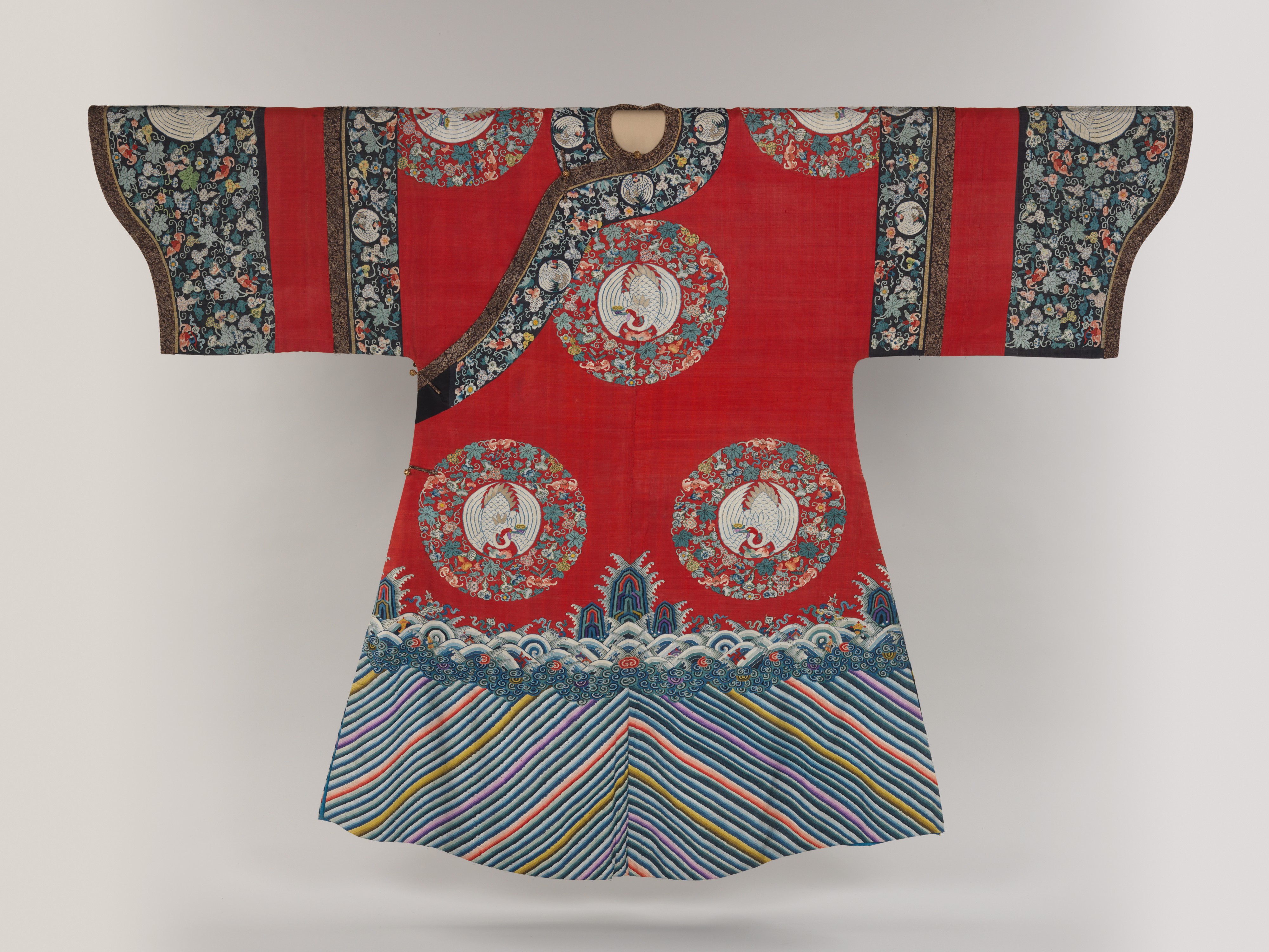
Context prevents symbolism from becoming a stereotype. On a robe for a special occasion, red can intensify a network of auspicious cranes, bats, gourds, and longevity fungi. On a painting, a small red seal may identify an artist or collector and balance a composition dominated by black ink. In Ming imperial art, red could suggest authority and court ceremony. In the twentieth and twenty-first centuries, it also acquired prominent national and revolutionary associations.
Occasion matters as much as object type. Clothing that feels celebratory at New Year or a wedding may be inappropriate at a solemn event. Etiquette also varies by community, so visitors should follow the host’s guidance instead of assuming that “red is always safe because it is lucky.” Likewise, a red warning sign or a negative figure printed in red depends on a modern functional code, not festival symbolism.
The same principle applies to other Chinese symbols. A Chinese dragon can refer to water, imperial power, ancestry, public celebration, or regional identity depending on its setting. Cultural literacy comes from reading combinations and contexts, not memorizing a one-word definition.
Red in Modern Chinese Design
Modern designers inherit an unusually powerful color. Restaurants and retailers use red to attract attention; festival campaigns pair it with gold; museums and cultural products draw on seal marks, lacquer surfaces, paper cutting, or textile patterns. Digital interfaces can reproduce intense vermilion at little cost, but effective design still depends on proportion. A small red accent can feel refined, while an undifferentiated red field may overwhelm text and imagery.

Contemporary use is most convincing when it understands the source rather than merely copying a “Chinese red” swatch. Lacquer suggests depth and patient layering; seal paste suggests authorship and authentication; wedding textiles suggest ceremony; New Year paper suggests renewal and shared wishes. Those distinctions allow tradition to support new design without reducing Chinese culture to one color.
Festival colors also work alongside seasonal foods, stories, and protective practices. The Dragon Boat Festival, for example, is best understood through the combined meanings of racing, remembrance, zongzi, plants, and regional ritual rather than through color alone.
Frequently Asked Questions
Is red always lucky in Chinese culture?
No. Red is strongly auspicious in celebrations, but its meaning depends on the object and occasion. It can also signal authority, artistic identity, political history, danger, or financial loss.
Why are red envelopes given?
They present money as a blessing within a social relationship. The red paper communicates celebration and good wishes, while the giver, recipient, amount, and timing depend on family and regional custom.
Why do many Chinese weddings use red?
Red makes joy, prosperity, fertility, and an auspicious beginning visible. Its use varies by era and region, and contemporary weddings may combine red Chinese attire with other styles.
What do red lanterns mean?
They commonly create a festive atmosphere and may express wishes for prosperity, reunion, or celebration. Their meaning changes with the festival, venue, inscriptions, and local tradition.
Did the Nian monster create the New Year tradition of using red?
The Nian story is popular folklore explaining why red, fire, and loud sounds repel danger. It should not be treated as a documented single origin for the many red decorations used during Lunar New Year.
Sources and Further Reading
- Smithsonian National Museum of Asian Art, “Red”.
- Smithsonian National Museum of Asian Art, “Lunar New Year”.
- Wang Tao, “Colour Terms in Shang Oracle Bone Inscriptions,” Bulletin of SOAS.
- Hong Kong Museum of History, “Joyous Destiny: A Selection of Wedding Memorabilia”.
- British Museum, Chinese New Year money envelope with 福.
Editorial Note
Written by Heritage Explorer, Founder & Editor of Explore China Heritage. This article separates material evidence, historical interpretation, festival folklore, and modern practice so that red is understood as a changing cultural language rather than a universal one-word symbol.


No comments